The Re-Platforming Payoff
Seven modules on how to survive the project. This one is about what you get for it...
Contents
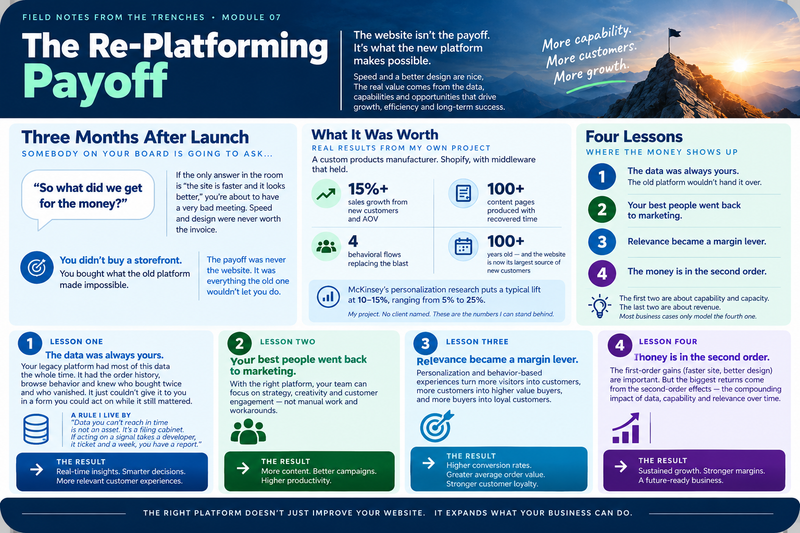
Three months after launch, somebody on your board is going to ask the question.
So what did we get for the money?
And if the only answer in the room is “the site is faster and it looks better,” you are about to have a very bad meeting. Because speed and design were never worth the number on that invoice.
You didn’t buy a storefront. You bought a set of things the old platform made impossible.
I’ve led four e-commerce implementations and served as architect and project leader on a custom ERP replacement. I’ve also sat on the other side of this — the Shopify implementation where I was the decision-maker and project leader, for a custom products manufacturer. So take this from someone who has actually run the business:
“The payoff was never the website. It was everything the old one wouldn’t let you do.”
Four lessons on where the money actually shows up, the numbers from my own project, and the question I’d ask if I sat on your board.
Lesson One: The data was always yours. The old platform just wouldn’t hand it over.
Here is the part that stings: your legacy platform had most of this data the whole time.
It had the order history. It had the browse behavior. It knew who bought twice and who bought once and vanished. It just couldn’t give any of it to you in a form you could act on while it still mattered — because it lived in tables nobody could join, behind an export that ran overnight, in a system that spoke to nothing else.
Module 01 called a re-platform a systems project, not a web design project. This is the bill coming due in your favor. What you bought was an addressable customer record, and it has three layers:
Identity — one key per customer, with email, phone, location, time zone, and consent on record. Not three conflicting records across three systems.
Transaction history — order count, lifetime spend, average order value, time since last purchase, the SKUs and categories they actually buy.
Behavior, in real time — products viewed, collections browsed, internal searches run, carts opened and abandoned, checkouts started and left.
That third layer is the one legacy platforms never delivered, and it’s the one that changes what marketing can do. Not what they know about a customer. What they know about a customer right now.
A rule I live by
Data you can’t reach in time is not an asset. It’s a filing cabinet.
If acting on a customer signal requires a developer, a ticket, and a week, you do not have a data advantage. You have a report.
Lesson Two: Your best people stopped maintaining data and started marketing
This is the payoff nobody puts in the business case, and in my experience it’s the biggest one.
Before the project, a meaningful share of my marketing team’s week went to moving data around. Reconciling lists. Exporting, cleaning, re-importing. Checking whether the thing that ran last night actually ran. Smart, expensive, creative people doing clerical work because the systems wouldn’t talk.
Module 03 argued that middleware is where integration budgets either die or pay for themselves. Here’s what paying for themselves looks like: the connections held, and the people who had been maintaining the data went back to marketing.
That’s not a soft benefit. Run it as arithmetic. Take the fraction of your marketing payroll currently spent on data janitorial work, multiply by the fully loaded cost of those people, and that number is a line item you recovered — every year, permanently, without hiring anybody.
Then ask the second question, which is bigger: what did those people produce once they had their time back?
In my case, over a hundred pieces of content. Which brings its own compounding return — more on that in a moment.
A rule I live by
Count the capacity you free, not just the cost you cut.
A re-platform that saves you money is a decent project. A re-platform that gives your best people their calendar back is a growth project. Most business cases only model the first one.
Lesson Three: Relevance became a margin lever
With an addressable customer record and people free to use it, the marketing changes shape.
You stop blasting. The batch-and-blast email — same message, entire list, Tuesday morning — is replaced by flows that fire on behavior. In my implementation we built segments and a flow for each of the ones that mattered:
New buyer — the welcome and second-purchase sequence, where repeat-customer economics are actually won
Abandoned cart — the highest-intent moment in e-commerce, and the easiest money on this list
Browse abandonment — interest without a cart, which legacy platforms simply could not see
Post-sale review request — which feeds the social proof that Module 06 showed now feeds AI recommendation engines
Four flows. Each one addressing a customer in a state the old platform couldn’t detect.
And the on-site experience stops being static. We deployed personalized recommendations across the home page, collection pages, product pages and checkout — the four places a shopper actually decides. Not a hand-built “you may also like” grid that somebody updates quarterly, but placements that respond to what this visitor is doing in this session.
I’ll be straight with you about the category, because this is where the hype lives. Recommendation engines are genuinely useful and they are not magic. They work by finding patterns in what people bought together and what this shopper has looked at. Several mature options exist and they are broadly comparable. The engine is not the hard part. Having clean product data and real behavioral signal to feed it is the hard part — which is Module 06’s argument, arriving from the other direction.
What it was worth, in my project: sales up more than 15%, from a combination of new customer growth and higher average order value — with significant growth in the years that followed.
For external corroboration, McKinsey’s personalization research found that doing this well typically produces a 10–15% revenue lift, with company-specific results ranging from 5% to 25%, and that companies excelling at it draw 40% more revenue from those activities than average performers. That research also found 71% of consumers expect personalized interactions and 76% are frustrated when they don’t get them.
Worth noting: that study is from November 2021. Those expectations have not softened in the five years since.
Lesson Four: The money is in the second order, not the first
Everything above is about the sale in front of you. The durable payoff is the next one.
Once you have a clean transaction history and a live behavioral stream in one place, the system stops only reporting backward and starts forecasting. Four numbers come out of it, and they are the ones I’d put on a dashboard:
Predicted customer lifetime value — expected spend over the coming year, per customer
Churn risk — the probability this customer doesn’t come back
Expected date of next order — when they’re statistically most likely to reorder
Average time between orders — their individual purchase cadence
Those four turn marketing from reactive to scheduled. You stop sending the win-back campaign after someone has already gone quiet for six months, and start sending it the week their own cadence says they’re due. You stop discounting your whole file and start spending retention budget on the customers whose churn risk says they need it.
That’s the difference between a mailing list and a customer base.
None of it was computable on the old stack. Not because the math is hard — it isn’t — but because the data to feed it lived in four systems that disagreed with each other.
A word to the next generation
Learn to read a customer file the way a merchant reads a floor.
Recency, frequency, value, cadence. Those four ideas are older than every platform you will ever work on, and every predictive model being sold today is a machine that computes them faster. Understand the ideas and the tools will never intimidate you.
The Scorecard: What to measure, so the board meeting goes differently
Before the next review, get these on one page:
Revenue from flows versus broadcasts. The ratio tells you how much of your marketing is behavioral and how much is still batch.
New customers from the site, trended against every other acquisition source you run.
AOV, before and after, and which placements moved it.
Marketing hours recovered from data maintenance, and what got produced with them.
Organic and AI-search visibility, trended against content published.
That last one deserves a note. Those hundred-plus content pages my team produced with their recovered time did what good content always did — built site authority and organic traffic, the asset Module 02 was about protecting. But they’re now also doing something that didn’t exist when this series started: feeding the answer engines from Module 06. The same work, paying twice.
Your next step
Write down three things your business can do this quarter that it physically could not do two years ago.
If you can’t fill all three lines, you didn’t finish the project. You just changed platforms.
If I Sat on Your Board: The question I’d ask
Not what it cost. That’s settled, and Module 04 told you how to count it.
What can we do now that we could not do before — and what is it worth in dollars this year?
Three possible answers. The site is faster means you bought a redesign and called it a transformation. We’re working on it means the capability is sitting there unused, which is the most expensive outcome of all. Here are three things, here’s what each is worth, here’s the trend means you ran a systems project and collected on it.
I’ll leave you with the one that stays with me.
The business I did this for is more than a hundred years old. It was built on a printed catalog, a mailing list, and a telephone. Today its website is the single largest source of new customers it has.
That is not a technology story. That’s a hundred-year-old company earning its next hundred years.
You didn’t suffer through the project for a prettier homepage. You suffered through it for the capability. Go use it.
This closes the E-Commerce Implementation Series. Module 01 argued it was a systems project. Modules 02 through 06 covered the traffic, the integrations, the true cost, the platform fit, and the machine-readable catalog. If you’ve been following along and you’re planning a project of your own, start with a complimentary consultation — I’ll tell you the truth about what it will take.
About the author
Gary Q. Smith — President, GQS Direct, LLC
Gary pairs four decades of P&L-accountable direct marketing leadership with practitioner-level command of today’s commerce stack. He is currently an AI evangelist and practitioner and has led four e-commerce website implementations and integrations, built marketing databases, was architect and project leader for a custom ERP system, and managed omnichannel marketing strategy and communications for several businesses.
Most consultants have studied these problems. GQS Direct has owned them.
Start with a complimentary consultation →
The E-Commerce Implementation Series
Module 01 — Re-Platforming Is a Systems Project, Not a Web Design Project
Module 03 — Middleware: The Key to Effective Integration and Project ROI
Module 04 — The Open-Source Paradox: Hidden Maintenance and DevOps Costs
Module 05 — Your B2B Buyer Is Not a Consumer With a Bigger Cart
Module 07 — The Re-Platforming Payoff (you are here)