Re-Platforming Is a Systems Project, Not a Web Design Project
The storefront everyone argues about is 30% of the work. The other 70% is what sinks the launch...
Contents
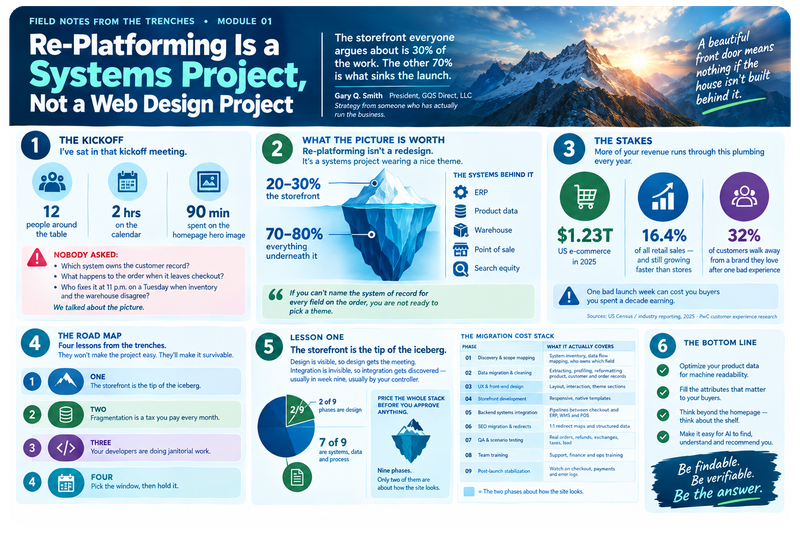
I’ve sat in that kickoff meeting.
Twelve people around a table. Two hours on the calendar. And ninety minutes of it spent on the homepage hero image.
Nobody asked which system owns the customer record. Nobody asked what happens to the order when it leaves checkout. Nobody asked who fixes it at 11 p.m. on a Tuesday when inventory and the warehouse disagree.
We talked about the picture.
Here’s what the picture is worth. On a mid-market re-platform, the customer-facing storefront is 20% to 30% of the real effort. The rest — 70% to 80% — goes into how your store talks to your ERP, your product data, your warehouse, your point of sale, and your search equity.
Re-platforming isn’t a redesign. It’s a systems project wearing a nice theme.
I’ve led four e-commerce implementations and served as architect and project leader on a custom ERP replacement. I’ve run the Shopify side of this — the migrations, the integrations, the launch weekends. So take this from someone who has actually run the business:
“If you can’t name the system of record for every field on the order, you are not ready to pick a theme.”
The stakes keep rising. US e-commerce passed $1.23 trillion in 2025 — about 16.4% of all retail sales, and still growing faster than stores. More of your revenue runs through this plumbing every year. And PwC’s research found that 32% of customers will walk away from a brand they love after a single bad experience. One bad launch week can cost you buyers you spent a decade earning.
Four lessons from the trenches. They won’t make the project easy. They’ll make it survivable.
Lesson One: The storefront is the tip of the iceberg
Design is visible, so design gets the meeting. Integration is invisible, so integration gets discovered — usually in week nine, usually by your controller.
Price the whole stack before you approve anything. Nine phases, and only two of them are about how the site looks:
The migration cost stack
Skullcandy’s move off BigCommerce is the clearest public example I’ve seen of where the work really sits. Their team went live in 90 days, with test orders flowing into NetSuite within the first 30. They retired a standalone product information system and ran catalog data natively. And the headline result wasn’t a prettier page — it was a five-step checkout collapsed into one, product pages loading in half the time, and 45% holiday revenue growth year over year.
None of that came from the theme. It came from the plumbing.
A rule I live by
Before anyone opens a design file, run a field-level data audit. List every system that holds customer, inventory, or order data. For each field, name the system of record — one system, not two.
Where two systems both claim a field, you’ve found your launch-week outage. In advance, for free.
Lesson Two: Fragmentation is a tax you pay every month
The average consumer brand runs hundreds of applications, and only a fraction of them talk to each other. I believe it. I’ve watched a team keep three systems honest with a spreadsheet and a prayer.
That fragmentation never shows up as a line item. It shows up as hours. Somebody reconciles inventory by hand every morning. Somebody cancels an order because the website sold what the store already sold. Somebody rebuilds the loyalty report because two systems disagree about who the customer is.
Starlight Knitting Society ran a Squarespace site, a Lightspeed register, two inventory systems, and spreadsheets for loyalty. Consolidating onto one Shopify platform gave them back two hours a day on inventory alone and more than 20 hours a week overall — plus organic search that went from nothing to 4,400+ daily impressions.
Slam Jam, coming off Salesforce Commerce Cloud, unified stores and online on Shopify POS. Daily orders rose 15% once the omnichannel plan switched on, and their setup and running costs fell 50%.
Unified commerce isn’t a buzzword. It’s one database your storefront, your registers, your B2B channel, and your back office all agree on. Everything else is reconciliation dressed up as strategy.
Lesson Three: Your developers are doing janitorial work
Walk into a company running a legacy or self-hosted store and look at what the technical team actually did last week. Patches. Hosting. Memory leaks. A certificate that expired. Plumbing.
Not one hour of it moved a single customer closer to buying.
The real argument for a managed platform isn’t the license cost. It’s where your people spend Monday morning. Skullcandy’s CEO framed the decision plainly: keep investing in development there, or free up the resources for product and marketing. After the move, launching a product across four regions went from a full day to about an hour.
Same team. Same payroll. Different work.
That’s the number I’d put in the board deck — not the platform fee.
A word to the next generation
The most valuable person on a re-platform isn’t the best developer in the room. It’s whoever can read a P&L and an API schema in the same afternoon.
Learn both. You’ll run the project, and eventually the company.
Lesson Four: Pick the window, then hold it
DNS propagates on its own schedule. Caches hold old redirects. Data cutovers find the one order status nobody mapped. All of that is survivable in March. None of it is survivable the week before Black Friday.
So set a hard deployment freeze at least 60 days before Black Friday, Cyber Monday, or whatever your peak is. Put it in writing at kickoff, before anyone is behind schedule and tempted to negotiate.
Tie the schedule to your systems, not to a marketing wish. J.Lindeberg replatformed to Shopify Plus in 16 weeks, timed to follow their new ERP going live — the sequence that makes sense, because the ERP decides what the store can promise. Sales came in 70% higher afterward, with conversion and average order value both up 7%.
Launch early and quiet. Spend the saved weeks stabilizing. Nobody ever regretted a boring launch.
If I Sat on Your Board: The question I’d ask
A re-platform fails for the same reason most technology projects fail. Not because the software was wrong — because the organization priced the visible 30% and hoped the rest would sort itself out.
So before you approve the budget, ask your team one question:
What percentage of this project is below the waterline — and who owns each of those systems?
If the answer is a shrug, you don’t have a plan. You have a theme.
Your next step
Before anyone talks redesign, run the field-level data audit. Every system holding customer, inventory, or order data. Every field. One named system of record for each.
It takes a week. It has saved every project I’ve run six figures and a very long launch weekend.
Get that right and the rest is scheduling. Get it wrong and the prettiest homepage in your category won’t save you.
Fix the plumbing first. Then pick the picture.
Next in this series — Module 02: Your Redirect Map Is Worth More Than Your Theme A re-platform can give back the organic traffic you spent a decade earning — the redirect map is where it happens.
About the author
Gary Q. Smith — President, GQS Direct, LLC
Gary pairs four decades of P&L-accountable direct marketing leadership with practitioner-level command of today’s commerce stack. He is currently an AI evangelist and practitioner and has led four e-commerce website implementations and integrations, built marketing databases, was architect and project leader for a custom ERP system, and managed omnichannel marketing strategy and communications for several businesses.
Most consultants have studied these problems. GQS Direct has owned them.
Start with a complimentary consultation →
The E-Commerce Implementation Series
Module 01 — Re-Platforming Is a Systems Project, Not a Web Design Project (you are here)
Module 03 — Middleware: The Key to Effective Integration and Project ROI
Module 04 — The Open-Source Paradox: Hidden Maintenance and DevOps Costs
Module 05 — Your B2B Buyer Is Not a Consumer With a Bigger Cart