Your B2B Buyer Is Not a Consumer With a Bigger Cart
Shopify, Adobe Commerce and OroCommerce — and how to tell which one your business actually needs...
Contents
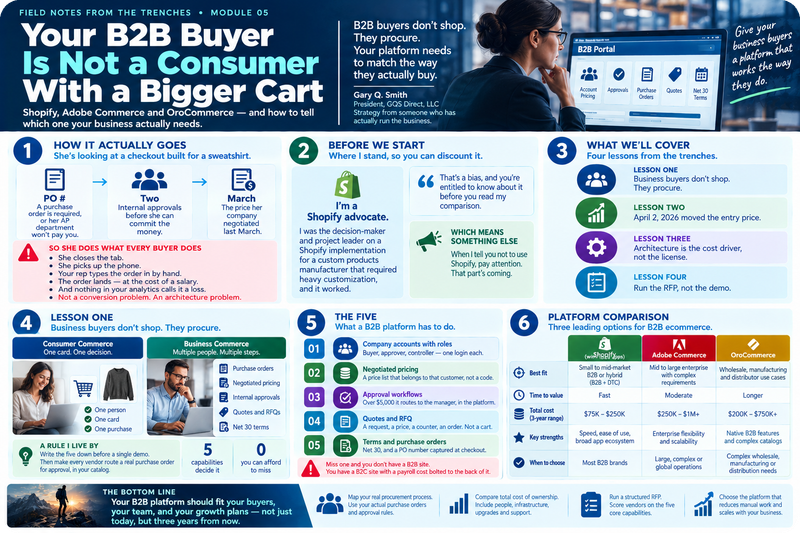
She needs a purchase order number, two internal approvals, and the price her company negotiated last March.
She is looking at a checkout built for somebody buying a sweatshirt.
So she does what every business buyer in America does when the website can’t do her job. She closes the tab, picks up the phone, and your customer service rep types the order in by hand — and now you are paying a salary to be a website.
That’s not a conversion problem. That’s an architecture problem.
Before I go further, you should know where I stand. I’m a Shopify advocate. I was the decision-maker and project leader on a Shopify implementation for a custom products manufacturer that required heavy customization, and it worked. That’s a bias, and you’re entitled to know about it before you read my comparison.
It also means something else: when I tell you not to use Shopify, pay attention. That part’s coming.
Module 04 taught you to count the three-year number. This module is about where you spend it. I’ve led four e-commerce implementations and served as architect and project leader on a custom ERP replacement, so take this from someone who has actually run the business:
“Retrofitting a consumer storefront to handle business purchasing is how you end up with a website that takes orders and a staff that fixes them.”
Four lessons, two tables, and the question I’d ask if I sat on your board.
Lesson One: Business buyers don’t shop. They procure.
Consumer commerce is one person, one card, one decision. Business commerce is none of those things.
Five capabilities decide whether a platform can carry your B2B business. Not fifty. Five.
Company accounts with roles. A buyer, an approver, a controller — one login each, different permissions, under one company. And one human who buys for three subsidiaries without three logins.
Negotiated pricing. Not a discount code. A price list that belongs to that customer, honors their contract, and never shows up in front of anyone else.
Approval workflows. Over five thousand dollars, it routes to the manager. That rule lives in the platform or it lives in somebody’s inbox.
Quotes and RFQ. A request comes in, a rep prices it, the buyer counters, it converts to an order. This is a negotiation, not a cart.
Terms and purchase orders. Net 30. A PO number captured at checkout, because without it their AP department won’t pay you.
Miss any one of them and you don’t have a B2B site. You have a B2C site with a manual process bolted to the back of it — and that process has a payroll cost that grows with your success.
A rule I live by
Write the five down before you take a single demo.
Every vendor can show you a beautiful storefront. Make them show you a purchase order routing for approval, with your actual dollar threshold, in your actual catalog. The demo that gets vague right there has answered you.
Lesson Two: April 2, 2026 moved the entry price
For years the answer to “I need B2B on Shopify” was “upgrade to Plus, $2,300 a month.” That stopped being true this spring.
On April 2, 2026, Shopify moved a block of core B2B capability down to the Basic, Grow and Advanced plans at no additional cost: company profiles, payment terms, volume pricing, ACH payments (US only), vaulted credit cards, and up to three active B2B catalogs assigned through Markets.
Read the plan prices against that. Basic is $39 a month. Grow is $105. Advanced is $399. Plus is $2,300 on a three-year term, $2,500 on one year.
A wholesale operation that needs three price tiers and Net 30 can now run on a $399-a-month plan. Three years of that is about $14,400. Three years of Plus is nearly $83,000.
That is the single most useful fact in this article, and most of the B2B comparisons you’ll read were written before it was true.
Now the other half, because this is where people get hurt. These stayed behind on Plus:
Unlimited catalogs for customer-specific pricing — more than three price lists and you’re going up
Direct catalog assignment to companies and locations
Partial payments and deposits
So the real question isn’t “do I need Plus.” It’s “how many distinct price lists do I actually have?” Three or fewer, and you have a very inexpensive answer. Four or more, or customer-specific pricing at account level, and you’re on Plus — and that’s a legitimate reason to be there.
Lesson Three: The architecture is the cost driver, not the license
Module 04’s argument was that the license is the smallest number. It’s just as true here, and in B2B it shows up as a question about where your customization lives.
Shopify keeps the core lean and pushes specialized capability to its app ecosystem. That’s a deliberate strategy and it works — but it means evaluating Shopify honestly requires you to evaluate the apps too. Quote negotiation, sales-rep ordering, tiered approvals: those are app territory. The companion piece to this module maps three configurations.
Adobe Commerce is now two different products wearing one name, and this is the trap.
The PaaS edition is what people mean when they say Magento — full PHP control, the Marketplace extension ecosystem, deep native B2B. Adobe Commerce as a Cloud Service, introduced in June 2025, is the SaaS edition. Adobe runs it, patches it, upgrades it versionlessly — all the things Module 04 said you should want.
And on it, PHP modules, Luma themes, and Magento Marketplace extensions do not run. Customization is out-of-process only: App Builder, API Mesh, webhooks. Base license limits run to 250,000 SKUs and 100 catalog variations.
B2B itself is there — Adobe shipped company management, purchase orders, quote management and requisition lists as storefront drop-ins beginning January 2026, with seller-assisted buying later in the year. Coverage is real but still filling in, so verify each capability you need against the current list rather than the brochure.
Here’s the honest reading: ACCS fixes the upgrade treadmill that Module 04 was about. It also removes the extension ecosystem that is most of why people chose Adobe Commerce for B2B. You can have the maintenance relief or the extension library. Not both. Go in knowing which one you’re buying.
OroCommerce is the one built for B2B from the start, and its pricing model has a detail worth knowing before you call. Oro licenses by GMV bands — the value of goods sold through the platform — and publishes no list price. Enterprise plans include 25 admin users. Your buyers and customer accounts don’t count against that; your internal people do. For a distributor with a large inside sales team, that is a real number, and it is not on any comparison chart.
The capability comparison
Strategic comparison, not a quote. Capability varies by plan, edition, deployment model and implementation partner.
Lesson Four: Run the RFP, not the demo
The three-year numbers, as planning ranges:
Projected three-year total cost of ownership
Two honesty notes. Adding every low together and every high together produces a wider band than any real project will land in — use these to size the decision, not to budget it. And Shopify applies a variable platform fee at higher volumes that it does not publish; if you’re approaching that scale, get the threshold and the cap in writing before you sign.
So don’t shop. Procure.
Document first. Strategy, three-year objectives, critical workflows, requirements. Don’t let a demo do your thinking.
Issue an RFP and require a written three-year TCO in every response.
Demand demos and references — customers your size, in your model, who will take your call.
Calculate ROI yourself. The vendor won’t, and executive management isn’t approving a platform. They’re approving a return.
For Shopify or Adobe, run the RFP through a certified solution partner rather than the vendor’s sales desk.
And the order I’d evaluate in:
Shopify first. Start here if your B2B requirements can be met natively or with modest app support — shortest timeline, lowest cost, least implementation risk. Especially if you’re hybrid B2B/B2C or D2C-first under $200 million. Don’t choose it if a key requirement can’t be met to your satisfaction. That’s the part people skip.
OroCommerce to the top if you’re a B2B-first manufacturer, industrial distributor, or multi-entity wholesaler where complex corporate buying rules are your revenue operation. Demo it against your actual contract pricing and approval hierarchies.
Adobe Commerce if you need extensive enterprise customization and have the technical resources to carry it — massive catalog complexity, 100,000+ SKUs, multi-brand regional networks from one admin. And decide PaaS versus ACCS deliberately, because that choice is irreversible in practice.
A word to the next generation
Learn to run a real RFP. Requirements first, scorecard second, demos last.
Anyone can be impressed by a demo. The professional is the one who wrote down what mattered before the sales engineer walked in — and that discipline will outlast every platform on this page.
Your next step
Count your distinct price lists. Then count your approval rules. Then count the orders your staff types in by hand every week.
Three numbers, one afternoon. They’ll narrow this decision faster than any comparison chart — including mine.
If I Sat on Your Board: The question I’d ask
Not which platform.
How many orders did your people key in by hand last month, and what did that cost us in salary?
Three possible answers. We don’t track that means the cost is real and invisible. A few hundred means you have a platform problem you’ve been calling a staffing problem. Eleven, and here’s why each one was an exception means your architecture fits your business.
Your buyer already knows what good looks like. She uses it at home every night.
She’s not asking you to be Amazon. She’s asking you to take her purchase order.
Next in this series — Module 06: Your Next Customer Won’t Have Eyes Agentic commerce arrived as a discovery channel, not a checkout — what to fix in your product data before the machines decide you don’t exist.
About the author
Gary Q. Smith — President, GQS Direct, LLC
Gary pairs four decades of P&L-accountable direct marketing leadership with practitioner-level command of today’s commerce stack. He is currently an AI evangelist and practitioner and has led four e-commerce website implementations and integrations, built marketing databases, was architect and project leader for a custom ERP system, and managed omnichannel marketing strategy and communications for several businesses.
Most consultants have studied these problems. GQS Direct has owned them.
Start with a complimentary consultation →
The E-Commerce Implementation Series
Module 01 — Re-Platforming Is a Systems Project, Not a Web Design Project
Module 03 — Middleware: The Key to Effective Integration and Project ROI
Module 04 — The Open-Source Paradox: Hidden Maintenance and DevOps Costs
Module 05 — Your B2B Buyer Is Not a Consumer With a Bigger Cart (you are here)