The $2.4 Million Blind Spot
What four decades of new-technology waves teach independent merchants about getting AI right...
Contents
I’ve seen this movie before.
In the 1990s, it was the marketing data warehouse. Then e-commerce platforms. Then marketing automation. Every wave came with the same promise and the same panic: buy now or be left behind.
The merchants who won were never the ones who bought first.
They were the ones who did the math first.
AI is the same movie with a much bigger budget. And the early reviews are brutal.
73% of businesses that attempt AI without a proper readiness assessment fail within the first year. McKinsey’s data puts the average loss at $2.4 million per failed project. Seven out of ten never make it past the pilot.
Those aren’t bad breaks. They’re unforced errors.
I’ve planned circulation for 40 million catalogs a year, grown e-commerce to nearly half of company sales, led Shopify and Klaviyo implementations, and served as lead architect on a custom ERP. I’ve sat on both sides of the vendor table. So take this from someone who has actually run the business:
“Diving into AI without an assessment isn’t innovation. It’s a gamble with house money — and the house is your business.”
Don’t measure this decision by next quarter. Ask where your business stands three to five years from now if you get it wrong — and where it stands if you get it right.
Here are the four lessons I’d want you to carry into that decision — the ones that put you among the 27% who succeed.
Lesson One: Clean data before clever models
Catalogers learned this decades ago. A mailing list full of duplicates and dead addresses doesn’t get better because you print a prettier catalog.
AI works the same way. It isn’t a magic wand. It’s a math problem, fed by your company’s history. If the history is a mess, the AI becomes an expensive mess.
Right now, 67% of small and mid-size companies have their data scattered across silos with no centralized strategy. A quick glance at your customer file won’t tell you whether you’re ready. The Standard will:
The AI Data Readiness Audit
A rule I live by: the One Week Rule
If it takes your team more than one week to extract and analyze a specific dataset, you aren’t ready for AI yet.
That’s not a failing grade. It’s a to-do list. Fix the plumbing before you buy the expensive faucet.
Lesson Two: Grow your own people first
The instinct is to hire a $300,000 data scientist on day one. Resist it. Hiring too early is one of the most reliable shortcuts to failure I know.
The AWS Playbook describes four ways to source talent:
Build — upskill your existing team. For most businesses, the only sustainable path, because your people already hold the institutional knowledge: how your customers buy, why your operations work the way they do. No outsider walks in with that.
Buy — hire fresh talent with foundational AI skills. Fast, expensive, and a real cultural risk.
Borrow — contractors for specialized, short-term needs.
Bot — let AI handle the task itself, essentially “hiring” the software.
The most valuable person in your building right now isn’t a coder. It’s the AI Translator — someone who understands the business problem and can turn it into technical requirements. Without that person, your technical team will build a $2.4 million paperweight.
A word to the next generation
If you’re early in your career, this is your moment. In every technology wave I’ve worked through, the people who could speak both languages — business and technology — ended up leading.
Learn the customer. Learn the P&L. Learn the tools. Become the translator. The industry needs you more than it knows.
Lesson Three: Budget for the humans
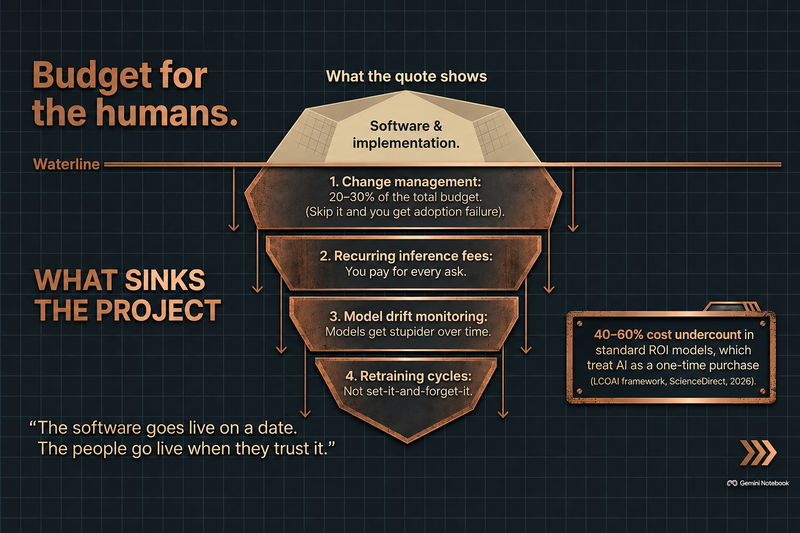
Every system implementation teaches the same lesson: the software goes live on a date. The people go live when they trust it.
That trust has a price. Alice Labs’ data shows change management consumes 20–30% of the total AI project budget — the Change Management Tax. Skip it, and you get adoption failure.
The traditional ROI model won’t warn you. The Levelized Cost of AI (LCOAI) framework, published in ScienceDirect in 2026, finds that standard models undercount costs by 40–60%, because they treat AI as a one-time purchase rather than a living operational system.
Before I review any AI budget, I want the Technology Readiness Level (TRL) assessed to set the contingency buffer:
TRL 1–3 (prototype): carry a ±50% contingency buffer.
TRL 7–9 (production-ready): you still need ±20%.
And I want to see these recurring costs in the plan — not discovered in year two:
Recurring inference fees — the cost of every “ask” you make of the model.
Model drift monitoring — models get “stupider” over time, and keeping them sharp costs money.
Retraining cycles — AI is not set-it-and-forget-it.
Lesson Four: Start small. Stay honest.
You don’t need a 50-page strategy deck. You need to test the water before you jump in. Here’s the process I recommend:
Pick one painful, repetitive task. Start with a low-risk annoyance — summarizing meetings or drafting follow-ups.
Choose one mainstream tool. Don’t shop for months. Pick a major general-purpose assistant and pay the $20–$30 a month for the paid version. Professionals pay for privacy — and for better data handling and quality.
Run a two-week test. That tool. That task. Period.
Write a one-page internal note. Document the how-to. That page is the seed of your official AI policy.
Expand slowly. Once it’s stable, add one more task or one more person.
And watch for the 90-Day Killers — the habits that sink good teams early:
Evaluating ten tools at once.
Starting with high-stakes, customer-facing work.
Shadow AI — keeping AI use secret from the team or leadership. Trust is your core asset. Don’t spend it here.
Treating one bad output as proof the technology “doesn’t work.”
If I Sat on Your Board: The question I’d ask
AI success is 20% technology and 80% people, process, and culture. That was true of every wave before this one, too. The technology is the easy part. Execution is what separates the survivors.
So as you look at next quarter’s budget, and the three to five years beyond it, ask yourself:
What is our Automation Readiness Score?
If you can’t answer that with hard numbers, you’re flying blind — and that’s a $2.4 million mistake waiting to happen.
But here’s the good news. You’re not behind. Not yet. The merchants who win this wave will be the ones who pause, measure, and move with purpose.
Be one of them. I’m glad to help you get there.
About the author
Gary Q. Smith — President, GQS Direct, LLC
Gary pairs four decades of P&L-accountable direct marketing leadership with practitioner-level command of today’s commerce stack. He is currently an AI evangelist and practitioner and has led four e-commerce website implementations and integrations, built marketing databases, was architect and project leader for a custom ERP system, and managed omnichannel marketing strategy and communications for several businesses.
Most consultants have studied these problems. GQS Direct has owned them.
Start with a complimentary consultation →